Draughts
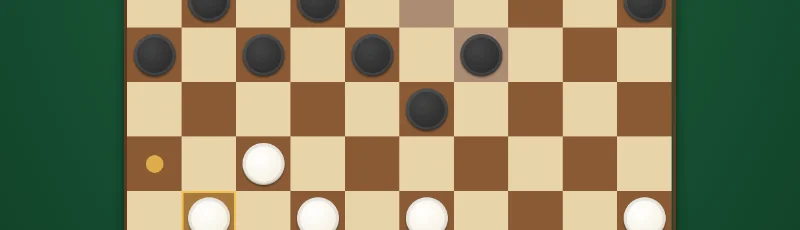
The second of the centre's board games: draughts two ways - English draughts on 8 by 8, checkers in America, and international draughts on 10 by 10 with its flying kings - with a friend, or the computer in the other seat.
Two games
- English draughts - checkers in America - on 8 by 8, twelve men each, Black moving first. Men move and capture diagonally forward; a man reaching the far row is crowned a king and moves and captures one square any way.
- International draughts on 10 by 10, twenty men each, White moving first. Men capture backwards too; a king flies, any distance along a diagonal, and the capture taking the most pieces must be made.
- In both a capture must be made if one can be, and a run of captures finished. A player who cannot move loses; the same position a third time is a draw.
At the table
- Two at a table, a person or the computer in each seat; or play alone against the computer whenever you like.
- Whoever sets a table up chooses its game, how well the computer plays - gently, steadily or its best - and whether hints are given.
- The first move goes to each player in turn, game by game; the table keeps the tally. The board is drawn from your side, the pieces that may move lit, and a run of captures made square by square. Either player may resign.
- Leader boards ranking a room's players by their points a game, a win a point and a draw half; and each game for visitors to try.
How our computer players think
Nothing is hidden in draughts, so the computer sees exactly what you do.
- It looks ahead: each move it could make, each reply, and so on - eight moves deep in English draughts at its best and six in international - and when the last move it looks at leaves a capture to make, it follows the captures to their end, so that it never stops looking in the middle of an exchange.
- It judges the positions it reaches by the pieces left: a king worth two and a half men or more, a man worth more the further on he is, the middle of the board and the back row worth holding. Of all its moves it plays the one whose worst outcome is best (minimax, with alpha-beta pruning to skip lines that cannot matter).
- Steadily it looks less far and adds a little chance; gently, less far still, more chance, and now and then a move at random.
- Ask for a hint and it lights the move it would make at its best, and says why, in the game's notation.
Its thinking runs in your own browser, in WebAssembly.
The other games
Back to the centre; how to find your way around, and what it costs (nothing): frequently asked questions.