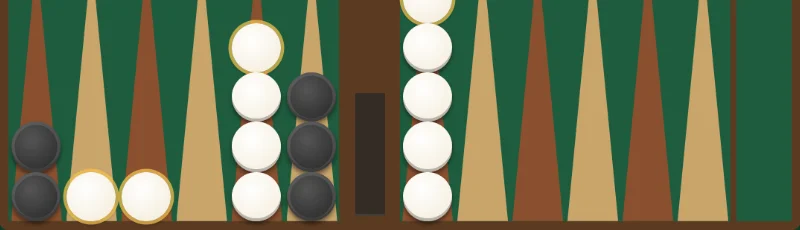
Backgammon
The third of the centre's board games: backgammon, the race of fifteen checkers round the board and off it, single games or matches, with the doubling cube - with a friend, or the computer in the other seat.
The game
- Fifteen checkers each, moving round the board in opposite directions to their own home board and off it; the dice say how far, a double played four times. The first to bear off all fifteen wins.
- A single checker on a point - a blot - can be hit and sent to the bar, to come in again from the start; two or more make a point the other side cannot land on.
- A game is worth 1 point, a gammon 2 if the loser has borne none off, a backgammon 3 if one of theirs is still on the bar or in the winner's home board besides; and the doubling cube doubles the stake.
At the table
- Two at a table, a person or the computer in each seat; or play alone against the computer whenever you like.
- Whoever sets a table up chooses single games or a match to 3, 5 or 7 points (with the Crawford rule), whether the cube is played, how well the computer plays - gently, steadily or its best - and whether hints are given.
- The dice are the table's own, from a random seed, the same for everybody there; the opening roll says who begins. The board is drawn from your side, the checkers that may move lit, a play made die by die with Undo, and the dice rolled for you when the cube is not yours to turn.
- Leader boards ranking a room's players by the points their games won; and the game for visitors to try.
How our computer players think
Nothing is hidden in backgammon but the dice to come, so the computer sees exactly what you do - the board and the roll - and no more.
- It weighs each play it could make by the position it leaves: the pips each side has to go, the points made - those in its home board and a run of them, a prime, most of all - anchors in yours, checkers on the bar, and every blot you could hit, counted by how many of the 36 rolls would hit it and how far it has come.
- At its best it looks a roll ahead: its likeliest plays tried against every roll you might throw and your best answer to each, and the play that does best on average taken.
- The cube by its chance to win: it doubles when strong enough that you should still take, and takes a double when it is a quarter or more to win. Steadily it looks less far; gently it adds chance, and now and then a play at random.
- Ask for a hint and it rings the checkers it would move and draws arrows to where they go - or says whether to double, take or drop - and why.
Its thinking runs in your own browser, in WebAssembly.
The other games
Back to the centre; how to find your way around, and what it costs (nothing): frequently asked questions.