Bridge
Contract bridge for four, at tables you sit down to from anywhere. Play with friends, against them, or with the computer in any seat nobody has taken - and practise alone whenever you like, the computer as your partner and both opponents.
At the table
Each table chooses its game - bridge, or minibridge for those learning - and the bidding system each partnership plays: SAYC, ACOL, 2/1 Game Forcing, Precision Club or Polish Club, or a system the centre adds. The two sides may play different systems, and the bidding cards of each are a click away at the table.
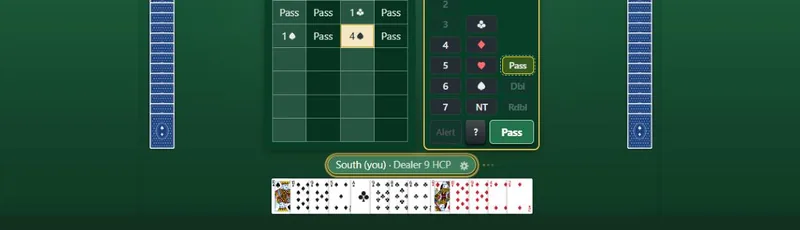
- Bid from a bidding box, play by dragging a card to the middle or double-clicking it; the auction, the contract and the tricks are always in the box at the corner of the table.
- A hint whenever you want one: the call or card the computer would choose for you, and why.
- Chat with the others at the table, or send one of the quick messages; friends may watch, with a password of their own if you want.
- At a social table the host may have a board bid again with the same cards, or played again from the opening lead.
- Every board has a reference, such as D-7Q2MH-9XRAB: give it on a room's page to play the same cards again at a table of your own.
Practising alone
A practice table is yours alone: choose your seat, have the computer bid and play the other three, or play your partner's hand too. See the other hands when you want to learn from a board, hand your own seat to the computer a call or a card at a time, and deal the next board when you are ready.
Clubs, sessions and results
- Scheduled tables and sessions: a club sets the time, players sit down, and the computer keeps any seat left empty.
- Every board kept and scored - by matchpoints or cross-IMPs for a session - with the results afterwards.
- Deal sets of a club's own, so that everybody in a session plays the same boards.
- Leader boards: a room keeps tables of a game waiting and ranks every game played at them, the computer's own results shown as a benchmark beside the players'.
- Your boards looked through after the game, or downloaded as PBN for any days you choose.
How our computer players think
Our bridge computer players use perfect-information Monte Carlo with policy-consistent sampling.
In plain words: a computer player knows only what its seat may know - its own hand, dummy once it is down, the auction, and the cards played so far. It never sees the other hands. So it works out what those hands could be by asking its own bidding rules which hands would have made the calls it has seen, and deals the unseen cards at random many times over, keeping only the deals that agree with every call and every card played. Where the bidding leaves few deals that fit, it walks from one that fits to the next by swapping cards between the hidden hands.
Each of those imagined deals is then solved double dummy - worked out exactly, as if its four hands were face up - by a double dummy solver. Only the deals the computer has imagined are ever solved, never the real one at the table. The call or card that does best across all of them is the one it makes.
- Bidding. Most of the auction is bid by the rules of the system each side plays. Where the opponents have bid and our side has found a suit, the computer tries each choice it is weighing - pass, double, or bid on - by bidding every imagined deal out to the end and scoring the contract it reaches.
- Declaring. As declarer and dummy it looks ahead at every card in the same way.
- Defending. From the third trick on, once the play has said something about the hands, the defenders look ahead too.
- On your device. All of this runs in your own browser, on as many of its cores as you allow - fewer on a phone that runs hot, from Settings for every game.
The other games
Back to the centre; how to find your way around, and what it costs (nothing): frequently asked questions.